Blue Origin Rocket Explosion 2026 Amazon’s $1.8 Billion Space Bet Just Got a Lot More Complicated
How the Cape Canaveral Static Fire Disaster Could Shake Amazon’s $1.8 Billion Space Bet — And What It Means for the Future of Commercial Spaceflight
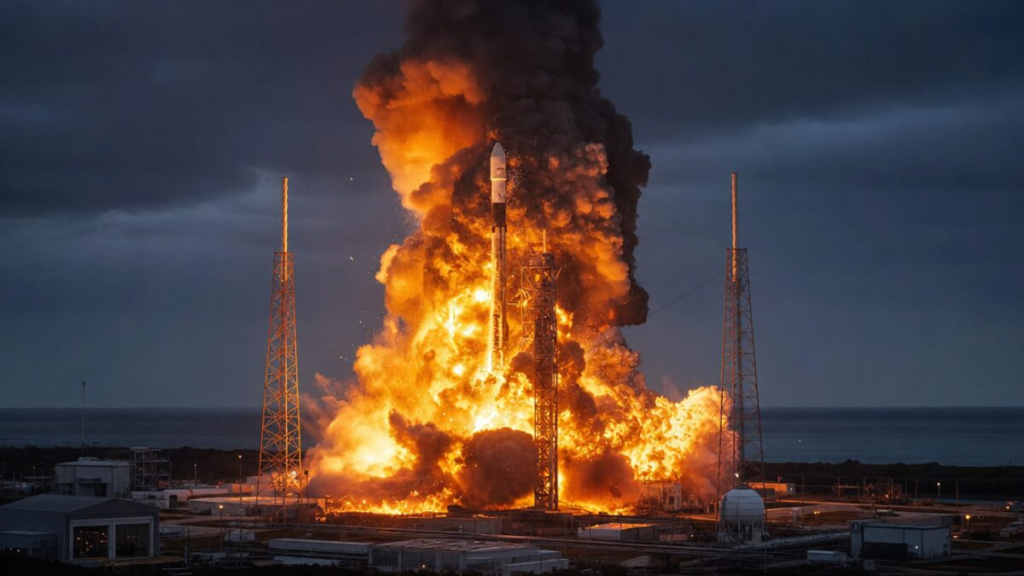
If you watched the sky above Cape Canaveral turn bright orange on the night of May 28th, 2026, you witnessed more than a dramatic fireball. You witnessed a pivotal moment in the commercial space race — one that has serious implications not just for Blue Origin, but for Amazon, Jeff Bezos, and billions of dollars in satellite internet ambitions.
Here is the full story.
💥 What Happened on May 28th, 2026?
A Blue Origin New Glenn rocket exploded on the launch tower during a static fire test of its engines at Cape Canaveral, Florida. A static fire test is a controlled, ground-based engine ignition designed to verify that rocket systems are functioning correctly before an actual launch. It is supposed to be a routine step in the pre-launch process.
On Thursday night, it was anything but routine.
The explosion shook nearby homes, briefly painted the sky orange, and drew immediate attention from the FAA — which confirmed it was aware of the anomaly and would be conducting an investigation before any further launches could be authorized.
This was not just a bad night for Blue Origin. It was a story with a billion-dollar plot twist — because Blue Origin and Amazon are far more deeply connected than most people realize.
📖 Want to go deeper on the space race? Check out Liftoff by Eric Berger — the definitive inside story of how SpaceX built its rocket program against all odds. A must-read for anyone following commercial spaceflight.
RELATED – The $1.75 Trillion Bet: Why the SpaceX IPO Is the Most Explosive Stock Market Event in Human History — And What It Means for YOUR Money
🔗 The Amazon–Blue Origin Connection Nobody Talks About Enough
Jeff Bezos founded Amazon. Jeff Bezos also founded Blue Origin. But the relationship between these two companies goes far deeper than a shared founder.
Amazon paid an estimated $1.8 billion to Blue Origin last year — nearly tripling its spending with Bezos’s space venture. The reason? Project Kuiper — Amazon’s plan to launch a constellation of low-Earth orbit satellites to provide global broadband internet access, competing directly with Elon Musk’s Starlink.
Blue Origin’s New Glenn rocket is central to launching those Kuiper satellites. Without it, Amazon’s global internet ambitions face serious delays — and Starlink extends its already significant head start.
This is the core of why the May 28th explosion matters so much: Amazon needs Blue Origin to succeed.
📡 Speaking of internet speed — while we wait for Project Kuiper, check out the best WiFi 6 routers on Amazon to maximize your current home internet performance.
🌌 How Big Does Bezos Think This Gets?
According to Bezos himself, Blue Origin will one day be bigger than Amazon — worth $2.4 trillion or more. He envisions Blue Origin as the infrastructure of humanity’s future in space — moving heavy industry off Earth, enabling millions of people to live and work beyond our atmosphere.
That is an extraordinary vision. And it makes every Blue Origin success or failure not just a business story — but a chapter in a much larger human saga.
📚 Explore Bezos’s vision in his own words — Invent and Wander: The Collected Writings of Jeff Bezos is a fascinating look at how the world’s most ambitious entrepreneur thinks about the future.
RELATED – How the Wealthy Use the Stock Market to Build Generational Wealth
📉 The Real Impact — What This Explosion Actually Means
1. Project Kuiper Delays Are Now Inevitable With New Glenn destroyed and an FAA investigation underway, Amazon’s Kuiper satellite deployment schedule faces real disruption. Every month of delay is a month that SpaceX’s Starlink tightens its grip on the global satellite internet market.
2. FAA Investigation — A Prolonged Grounding The FAA does not allow launches to resume until a formal investigation is complete and corrective actions are verified. This process can take months, during which Blue Origin’s commercial launch cadence is effectively frozen.
3. Financial Losses in the Hundreds of Millions New Glenn rockets cost hundreds of millions of dollars to build. Add pad repairs, investigation costs, and insurance implications — and the financial hit is enormous.
4. Competitive Credibility Takes a Hit SpaceX’s Falcon 9 has achieved an extraordinary reliability record. Every Blue Origin anomaly gives satellite customers another reason to look at alternative providers.
5. The Bezos Legacy Is on the Line Bezos has staked not just his money but his legacy on Blue Origin. How the company responds to this moment will define whether his trillion-dollar prediction is visionary or premature.
🌠 Inspired by space? Bring the cosmos home with a star projector for your bedroom — one of Amazon’s top-rated space gifts for adults and kids alike.
🔭 The Road Ahead — Setback or Turning Point?
History tells us that rocket failures are not automatically fatal to a program. SpaceX experienced multiple catastrophic failures before becoming the world’s most reliable launch provider. Resilience, transparency, and rapid iteration are what separate programs that survive from those that don’t.
The question for Blue Origin is not whether the explosion happened — it’s how they respond. A clear investigation, honest communication, and a swift return to the pad would signal organizational strength. A prolonged silence or regulatory battle would suggest something more troubling.
For those of us watching the space race unfold — and rooting for humanity’s future beyond Earth — this is a moment that calls for patience, perspective, and a good book about rockets.
🚀 Our top space reading picks on Amazon:
- Liftoff by Eric Berger — The SpaceX origin story
- Invent and Wander by Jeff Bezos — Bezos in his own words
- The Elon Musk Biography by Walter Isaacson — The definitive account of the space race’s central figure
RELATED – Turning Uncertainty into Opportunity: The Case for Learning Day Trading
💡 Final Thoughts
The sky over Cape Canaveral turned orange for a few dramatic minutes on May 28th, 2026. But the long-term story of whether Blue Origin can fulfill its extraordinary promise — and whether Amazon’s $1.8 billion bet will pay off — is just beginning.
Stay tuned. The space race is far from over.
🔭 Explore the universe from your backyard — check out the best beginner telescopes on Amazon and start stargazing tonight.
⚠️ Affiliate Disclosure: This post contains Amazon affiliate links. As an Amazon Influencer, I may earn a commission on qualifying purchases at no additional cost to you. All recommendations are genuine and based on relevance to the topic.